
Home
Tinnitus Research Initiative is a non-profit foundation dedicated to the development of effective treatments for all types of tinnitus so that relief can be obtained by everyone who suffers from it.
Recent Findings from the Workbench of TRI - click here
NEWS
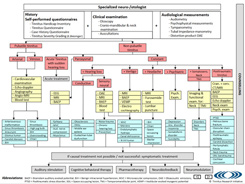
TRI FLOWCHART FOR PATIENT MANAGEMENT NOW ONLINE!
Click on the image to open the interactive PDF-file (1,07 MB)
The TRI Tinnitus Clinic Network has developed the "TRI Flowchart for Patient Management" based on careful literature research, performed in August 2008 and further updated since then.
First presented in 2009 during the 3rd TRI Meeting in Stresa, the Flowchart now is openly available for everybody.
This flowchart is an interactive PDF-document. You find detailed information by clicking the boxes of the main flowchart slide. Links to explanatory slides are always marked by an arrow. By clicking on the "home" symbol in the bottom right corner you get easily back to the main slide.
This flowchart should not be considered as a "final version" but rather as "work in progress". The flowchart is intended to be a "living document" and thus the quality and actuality of the flowchart will depend on your feedback.
Please send your comments and suggestions to the following e-mail address: info<at>tinnitusresearch.org.
The authors will be very grateful for all kinds of feedback.
We hope that this flowchart will contribute to a better diagnosis and treatment of the many tinnitus patients worldwide, who seek help.
THE TINNITUS RESEARCH INITIATIVE (TRI) DATABASE:
A new approach for delineation of tinnitus subtypes and generation of predictors for treatment outcome
Many tinnitus treatment studies revealed negative results when the average improvement was analysed. At the same time in almost all studies there have been treatment resoponders. This is probably due to the fact that there are different froms of tinnitus which respond to different treatments.
In order to improve treatment possibilities for tinnitus patients, TRI established an international database of tinnitus patients. Patients, who undergo specific tinnitus treatments, are assessed during the course of this treatment by using standardized instruments (e.g., psychoacoustic measures, questionnaires). The goals of this database are to increase the knowledge about the efficacy of specific therapies for specific subgroups of tinnitus patients.The final goal is that the database will provide information about the best therapy for an individual patient based on his clinical characteristics. Every interested researcher is welcome to contribute to the database.
read more
Link to the TINNITUS DATABASE Website
NEWSLETTER
The
latest newsletter offers a table of interesting upcoming
meetings, recently published literature and ongoing clinical trials
Newsletter archive
 
 
4th INTERNATIONAL TRI TINNITUS CONFERENCE 2010
Frontiers in Tinnitus Research
We want to thank all of the participants for their active and constructive participation in the 4th International Tinnitus Conference.
We Must Cure Tinnitus, We Can Cure Tinnitus and We Will Cure Tinnitus
Four years ago, when the TRI was founded, we made a pledge to cure tinnitus. The ultimate goal is to silence the phantom sound, and hereby to improve the quality of life of our patients. That pledge still stands: we must cure tinnitus. The question is: can we?
read more
The abstract book and recordings of the presentations are available for download now on the
Webpage of the 4th International TRI Conference 2010
TEXTBOOK OF TINNITUS
A new tinnitus book is under way.
Again it is Aage Møller, who initiated this project, and who coordinates the effort of a
large number of scientists and clinicians within the TRI community. The
book “Textbook of Tinnitus” will be published in October 2010 by Springer.
read more and subscribe
A TESTABLE MODEL FOR TINNITUS
Tinnitus, the most common auditory disorder, affects about 40 million people in the United States alone. Although several approaches for the alleviation of tinnitus exist, there is as of yet no cure. The present article proposes a testable model for tinnitus that is grounded in recent findings from human imaging and focuses on brain areas in cortex, thalamus, and ventral striatum. Hopefully, this model will guide ongoing research on the circuit mechanisms of tinnitus and provide potential avenues for effective treatment.
Tuning Out the Noise: Limbic-Auditory Interactions in Tinnitus
Josef P. Rauschecker, Amber M. Leaver, Mark Mühlau
NHS EVIDENCE - ENT AND AUDIOLOGY
NHS Evidence - ENT and Audiology is a unique, NHS-funded resource that aims to provide healthcare professionals with access to the best available evidence in ENT, audiology and thyroid disorders. The collection produces free bi-monthly email updates of recent guidelines, systematic reviews and events.
To join the mailing list and find out more visit